Home made
STORIES
Exploring horror, psychology, dystopia, memory, technology, and the fragile architecture of human existence.
01.
Can I walk you home?
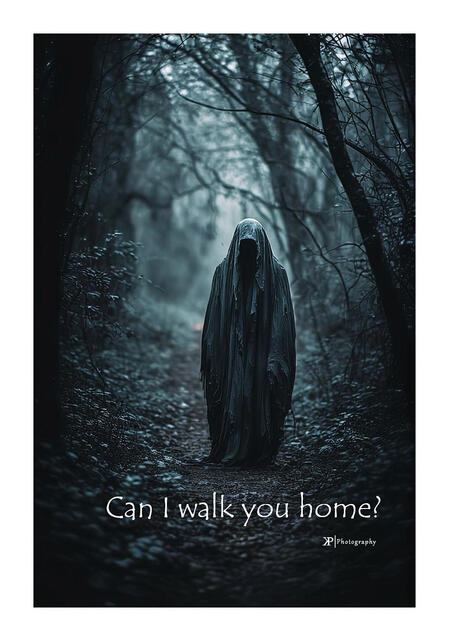
The figure had been waiting beside the forest road long before Adam noticed it.Rain drifted softly through the trees, thin as smoke, gathering on dead branches and black earth. The road itself was barely visible beneath layers of wet leaves. Somewhere in the distance, a dog barked once and then fell silent, as though even sound understood it should not travel too far into this place.Adam slowed his pace.The figure stood motionless beneath the crooked trees, wrapped in layers of dark fabric that moved gently in the wind. No face was visible beneath the hood. Only darkness.Under ordinary circumstances Adam might have turned around.But these were not ordinary circumstances.The hospital bracelet was still around his wrist.He laughed quietly to himself.“So today is the day, right?”The figure tilted its head slightly.“I’m afraid so.”Its voice was calm. Neither male nor female. Old without sounding elderly. The kind of voice one imagined speaking softly in empty churches.Adam stared at the wet road ahead.“Well,” he muttered, reaching into his pocket, “can I have a cigarette first?”A pale hand emerged slowly from beneath the dark fabric and offered him a lighter before he had even found one.“You should know smoking isn’t healthy.”Adam barked out a short laugh despite himself.“Will it make any difference in my case?”The figure was silent for a moment.“No,” it admitted quietly. “Not really.”The cigarette trembled slightly between Adam’s fingers as he lit it.Strangely, he no longer felt afraid.Not because he had accepted death. He had not. No one truly accepted it. Human beings merely became exhausted from resisting the inevitable.But the figure beside him did not feel cruel.Only tired.“Can I ask something?” Adam said after a while.“Of course.”“Are you Death?”Rainwater dripped slowly from the hood.“Yes.”Adam expected thunder after that answer. Or cold wind. Or perhaps some deep instinctive terror rising from ancient parts of the human mind.Instead there was only silence and the soft crackle of burning tobacco.“Huh,” he whispered eventually. “You’re less dramatic than paintings make you look.”A faint movement beneath the hood suggested amusement.“Paintings are made by the living.”They began walking together down the narrow forest road.Adam noticed that Death matched his pace exactly, never walking ahead, never behind. Like someone accompanying an elderly relative home after a long evening.“You know,” Adam said eventually, “you look exactly how I imagined.”“Yes.”“That must make your job easier.”“No,” Death replied softly. “Only easier for humans.”Adam glanced sideways.“What does that mean?”For a moment the figure said nothing. The rain intensified around them, whispering through the trees like distant voices.“Human beings cannot endure uncertainty for very long,” Death said at last. “So they create faces for things they fear. Over thousands of years they created mine.”Adam exhaled smoke slowly into the cold air.“The hood. The darkness. All that?”“The bones. The graveyards. The monsters beneath beds.” Death lowered its head slightly. “I wear the shape humanity gave me because it comforts people more than the truth.”Adam frowned.“That’s comforting?”“In a strange way, yes. People fear me less when I resemble their expectations.”They walked further into the forest.The road curved gently downhill now. Mist drifted low across the ground between tree roots like pale rivers.Adam studied the figure beside him carefully.“So what do you really look like?”Death was quiet for a very long time.Then:“I don’t remember anymore.”The answer disturbed Adam more deeply than anything else that evening.“Wait… what?”“I have worn humanity’s imagination for so long that I no longer know which parts belong to me.”The cigarette nearly slipped from Adam’s fingers.“That’s… horrifying.”“Yes,” Death whispered. “I think so too.”They continued walking.Adam suddenly became aware of how exhausted the figure sounded. Not physically. Something deeper than fatigue. The exhaustion of endless witnessing.“How long have you been doing this?”“Since the first living thing realized it did not want to stop living.”Adam stared ahead quietly.“So before humans?”“Oh yes.”“What were you then?”Death looked upward through the trees toward the invisible sky.“Smaller.”The answer lingered strangely in the air between them.“When life began,” Death continued softly, “I was only change. A transition. Cells making room for other cells. Nothing feared me then because nothing understood permanence yet.”“And humans changed that.”“Yes.”The forest grew darker around them.Adam noticed there were no animal sounds anymore. No birds. No insects. Only footsteps against wet earth.“Human beings,” Death said quietly, “were the first creatures to look at me and imagine injustice.”Adam took another drag from the cigarette.“That’s because dying feels unfair.”“I know.”There was no defensiveness in the answer.Only sadness.Adam looked sideways again.And for the first time, he felt pity.Not fear.Pity.“How many people have you walked like this?”Death considered the question.“I stopped counting after the plagues.”“That many?”“I was very busy in the fourteenth century.”Adam laughed despite himself.To his surprise, Death laughed too.Not ominously.Not monstrously.Just tired amusement shared between two travelers walking the same road.The sound was strangely human.Then Adam asked the question no one had apparently asked before.“How are you?”Death stopped walking.The forest itself seemed to pause with it.Rain continued falling softly through the branches, but everything else became utterly still.Slowly, Death turned toward him.Adam could not see a face beneath the hood, yet somehow he felt the weight of absolute astonishment.“What?”“How are you?” Adam repeated awkwardly. “I mean… everyone talks about themselves when they meet you. Nobody probably asks what your existence is like.”For several seconds Death said nothing.Then it looked away.“I don’t know.”The honesty of the answer nearly broke Adam’s heart.“You don’t know?”“No one has ever asked me to think about it before.”The road ahead disappeared deeper into fog.Death resumed walking more slowly now.“When humans see me,” it said quietly, “they scream. Or bargain. Or pray. Some curse me. Some collapse. Some pretend bravery.” A pause. “Very few speak to me as though I am also… something living.”Adam swallowed hard.“You’re lonely.”“Yes.”The word was almost inaudible beneath the rain.Death folded its hands beneath the dark robes.“I have escorted every living creature toward the end of its existence, yet no one walks beside me afterward.”Something about that sentence felt unbearably ancient.Adam suddenly understood why the figure looked the way it did.Not because Death was monstrous.Because humanity could not emotionally survive seeing compassion inside the thing they feared most.A kinder face would have been more terrifying.“Do you know what the worst part is?” Death asked softly.“What?”“Most humans spend their entire lives terrified that I am coming for them.” The hood lowered slightly. “But that was never my role.”Adam frowned.“Then what is your role?”Death looked ahead into the darkness beyond the trees.“To make sure nobody leaves alone.”The cigarette had nearly burned down to Adam’s fingers.He stared at it quietly before dropping it into the wet mud beside the road.For a while they walked in silence again.Then Adam spoke carefully.“You know… if humans created the way you look…” He hesitated. “Maybe you should choose another form.”Death gave a faint, weary laugh.“I wouldn’t know how.”The forest was thinning now.Ahead, through drifting mist, Adam could see pale light somewhere beyond the trees.Warm light.Home-like light.He slowed his pace slightly.“So this is it?”“Yes.”Oddly enough, he felt disappointed.Not because he wanted to die.But because he suddenly realized how terrible it would be to continue existing as the loneliest being in creation.“Can I ask one last thing?”“Of course.”Adam looked directly toward the darkness beneath the hood.“What would you want to look like?”Death became very still.When it answered, its voice was softer than rain.“Something people would not be afraid to embrace.”Adam felt tears gathering unexpectedly in his eyes.The light ahead grew brighter now.The road was ending.Death stopped walking.“It’s time.”Adam nodded slowly.Then, after a long silence, he stepped forward and gently embraced the dark figure beneath the trees.At first Death did not move.As though the gesture belonged to a language it had forgotten existed.Then, slowly, uncertainly, two cold hands rose and returned the embrace.And for the briefest moment, the forest around them no longer felt frightening.Only unbearably sad.When Adam finally let go, he noticed something strange.The darkness beneath the hood was gone.Not entirely.But enough for him to glimpse a face that looked neither skeletal nor monstrous.Only profoundly tired.And profoundly kind.Then the light consumed the road ahead.Death remained alone beneath the trees once more.Waiting for the next frightened soul to walk home.
02.
Flowers of Fear
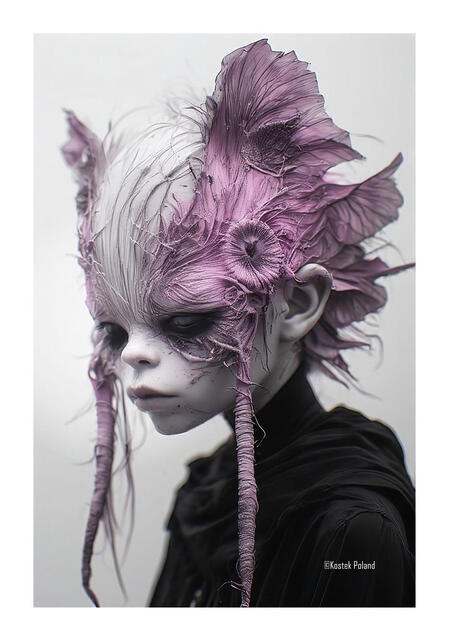
The greenhouse had been dead for thirty years, yet nothing inside it had truly decayed.The villagers avoided the road leading toward the old estate even during daylight. Moss had swallowed the stone walls, and the iron structure of the greenhouse leaned crookedly against the gray sky like the ribcage of some enormous animal left to rot in the forest. Children whispered stories about lights moving behind the shattered glass at night. Hunters claimed the air around the place felt unnaturally warm in winter.No one stayed there long enough to verify either story.Leon came because he did not believe in stories anymore.Fear, in his experience, was usually poverty, disease, loneliness, or memory. Ghosts were inventions made by tired minds attempting to give shape to grief. He had built an online following photographing abandoned places across Europe — ruined churches, flooded hospitals, military bunkers hollowed out by time. People admired the atmosphere in his images because they mistook emptiness for mystery.But the greenhouse disturbed him immediately.Not because of what he saw.Because of what he felt.The silence was wrong.Not the ordinary silence of abandoned buildings, where wind moved through broken corridors and distant birds filled the gaps between sounds. This silence felt attentive. As though the structure itself were listening.His boots crushed fragments of blackened glass beneath him while he moved deeper inside.Dead vines hung from the ceiling beams like veins torn from a body. Rusted gardening tools lay scattered across overturned tables. The air smelled of wet soil and something faintly sweet underneath it — floral, almost pleasant, until it lingered too long in the lungs.Then he saw the flower.It stood alone in the center of the greenhouse beneath the collapsed remains of the roof, illuminated by pale afternoon light. Crimson petals folded around themselves like layers of living flesh. The flower appeared untouched by time, impossibly vibrant amid the ruin surrounding it.Leon slowly raised his camera.The lens focused.And for a brief moment, he felt an absurd hesitation.As if photographing the thing required permission.He almost laughed at himself before pressing the shutter.The click echoed sharply through the greenhouse.Then the flower moved.Its petals trembled softly.Opening.Not blooming — awakening.A dim orange glow emerged from within the center of the flower. Two circular lights stared outward from the darkness between the petals.Eyes.Leon froze.The glow pulsed gently, like embers breathing beneath ash.Then a voice entered his mind.Not through his ears.Inside him.Cold.Ancient.Why did you wake me?Leon stumbled backward so violently he nearly dropped the camera. The greenhouse seemed darker now, though the sky above remained unchanged. Around him, dried roots began shifting across the floor with a soft scraping sound.He turned to run.And saw the girl standing behind him.She could not have been older than sixteen.Her skin was pale enough to resemble porcelain beneath the dim light. Black fabric covered her thin body like mourning clothes from another century. But the left side of her face was no longer entirely human. Violet petals stretched outward from her cheek and temple in delicate organic layers, threaded with thin fibers resembling roots or nerves. A dark blossom rested near her ear like an additional organ grown from beneath the skin.Her eyes carried no surprise.Only sadness.“You shouldn’t have taken the photograph,” she whispered.Leon stared at her speechless.The roots continued moving slowly around their feet.“Who are you?”The girl looked toward the flower.“My father called me Livia.”The name stirred something in Leon’s memory. Before coming here he had read fragments of local rumors online — a fire decades ago, a missing child, a grieving gardener who later killed himself.“You died here,” he said quietly.“No,” she answered. “Something else did.”The flower behind them opened wider.Warm orange light spilled across the shattered greenhouse floor. Leon noticed movement inside the petals — not clearly visible, only the impression of shapes folding endlessly inward like organs hidden within a body too deep to understand.“You need to leave,” Livia said.But Leon’s fear had already begun transforming into fascination.Photographers, scientists, explorers — all shared the same fatal weakness. The belief that seeing something grants ownership over it.“What is it?” he asked.Livia remained silent for a long moment.Then she spoke carefully, as if translating thoughts not entirely human.“My father found it beneath the roots of the greenhouse. Buried deep underground inside black soil that did not belong here. At night it would glow beneath the earth like an eye opening under water.”As she spoke, Leon noticed the petals growing slowly along her skin seemed to react to her words, trembling faintly.“He thought it was a rare species. He brought it inside and cared for it. Fed it warmth. Water. Light.”The flower pulsed again behind them.“And then it began listening.”A cold sensation spread through Leon’s chest.“What do you mean?”“It listened to loneliness first,” she said softly. “Plants understand loneliness better than people do.”The roots around the greenhouse walls shifted gently, almost affectionately.“I used to sit beside it for hours. I spoke to it because I was lonely too. I was sick. Children feared me before I became this.” She touched the violet growths near her face with thin pale fingers. “But it listened.”The silence that followed felt immense.Then she added:“And eventually it answered.”The orange eyes inside the flower widened slightly.Leon realized with growing horror that they were not eyes in any biological sense. They were openings. Windows into depth. Like looking through cracks into a place where light itself behaved differently.“What is it?” he repeated.This time Livia looked directly at him.“I don’t think human language was made for things that sleep beneath roots.”A violent sound suddenly echoed above them.The greenhouse structure groaned.Leon turned instinctively toward the ceiling. Thick black vines were descending slowly from the iron beams overhead. They moved with terrible patience, like deep-sea creatures drifting through water.“You woke it,” Livia whispered.The flower began unfolding further than any natural bloom should. Layer after layer of crimson flesh peeled backward, exposing darkness inside that appeared impossibly large compared to the size of the plant itself.Leon heard breathing.Not from lungs.From the greenhouse itself.The walls vibrated softly.Soil shifted beneath his feet.And the voice returned.The world still exists.The sentence carried neither joy nor anger.Only realization.Livia closed her eyes as if hearing something painful.“It dreams beneath forests,” she whispered. “Beneath gardens. Beneath every root system touching the earth. Most of the time it sleeps. But sometimes people dig too deep.”The roots suddenly tightened around Leon’s boots.He gasped, trying to pull free, but more vines wrapped around his legs with horrifying strength. Their surfaces felt warm and disturbingly soft, almost muscular beneath the bark-like texture.Panic finally overwhelmed curiosity.Leon struggled violently.“What does it want?”Livia looked at him with genuine pity.“To be remembered.”The flower pulsed brighter.Inside the darkness between the petals, Leon thought he saw faces emerging briefly and dissolving again — human shapes suspended within layers of roots and floral tissue like memories preserved inside living flesh.The missing.The forgotten.Fed into something vast beneath the soil.Livia stepped closer toward him.For the first time, Leon noticed tears running silently down her pale face.“When the fire started, my father thought he could destroy it.” Her voice trembled faintly. “But fire only taught it fear.”The roots climbed higher around Leon’s body.He could no longer feel his legs.The greenhouse had become fully alive now. Every vine trembled with slow respiration. Every flower hidden in the darkness seemed partially open, revealing tiny orange lights within.Watching.Waiting.The voice entered his mind one final time.Why are humans always surprised that the earth can look back?Leon screamed then, though the sound felt tiny against the immense breathing surrounding him.Livia touched his face gently.And for one terrible moment, her expression became almost loving.“You should never have answered its call.”The last thing Leon saw before the roots covered his eyes was the crimson flower unfolding completely at the center of the greenhouse.At its heart was not a creature.Not exactly.Only an endless depth filled with glowing orange lights, stretching downward forever through soil and darkness beneath the world.Like a sleeping intelligence hidden beneath every forest on Earth.Waiting patiently for someone else to wake it again.
03.
The Point-Time Hypothesis
A Higher-Dimensional Origin of Time and Reality
One of the deepest assumptions in modern physics is that time possesses extension. Whether treated as a continuous dimension in relativity or as a parameter in quantum mechanics, time is almost always assumed to exist as something through which physical systems evolve. Even theories that question the nature of spacetime generally retain the idea that temporal ordering exists in some fundamental form.
This paper explores a different possibility.
What if time is not a dimension with measurable extension at all?
Suppose that time is fundamentally point-like—a dimensionless entity rather than a continuous axis. In such a Universe there is no objective "before" or "after." Past and future do not exist as physical regions of reality but emerge only as informational constructs created by observers comparing different relationships within a complete system.
If time possesses no extension, then motion cannot be fundamental either. Nothing truly travels through time because there is no temporal distance to traverse. What we interpret as motion, evolution and causality would instead arise from changes in relational information observed from within the system itself.
This immediately raises another question.
If temporal evolution is emergent, must physical multiplicity also be emergent?
Perhaps the Universe is not composed of countless independent particles. Instead, there may exist only one fundamental physical entity—whether understood as matter, energy, information, light or some more primitive substrate. Every elementary particle, every field and every astronomical structure could simply represent different manifestations of the same underlying reality viewed from different observational perspectives.
The apparent diversity of nature would therefore not arise from multiple independent objects but from different relational configurations of a single universal structure.
This idea becomes even more interesting when considered alongside one of the most mysterious boundaries in theoretical physics: the Planck scale.
Conventionally, the Planck length (approximately 1.616 × 10⁻³⁵ metres) and the Planck time (approximately 5.39 × 10⁻⁴⁴ seconds) are regarded as scales below which our current theories lose predictive power. They are usually interpreted as practical limits beyond which quantum gravity becomes unavoidable.
This hypothesis proposes a different interpretation.
Rather than representing merely the smallest meaningful measurements, the Planck length and Planck time may define a genuine physical boundary separating two distinct geometric descriptions of reality.
Above this boundary the Universe appears as the familiar four-dimensional spacetime described by relativity and quantum field theory. Distances, durations, particles and causal relationships emerge as stable and measurable concepts.
Below the Planck boundary, however, these concepts may gradually lose their physical meaning. Distance may cease to exist as an independent quantity. Duration may disappear entirely. Individual particles may no longer possess objective identity.
Instead, reality may become fully described only within a higher-dimensional geometry.
If proposals such as M-theory correctly capture aspects of fundamental physics, this deeper structure could contain eleven dimensions rather than the four directly accessible to observation. These additional dimensions should not necessarily be imagined as hidden spatial directions waiting to be discovered. They may instead represent degrees of freedom that become inaccessible once reality is projected into the four-dimensional spacetime experienced by macroscopic observers.
In this picture, our observable Universe is not the complete structure of reality but an effective projection of a richer geometric framework.
The consequences of such an interpretation are profound.
Time would not simply emerge from physical processes.
Time itself would emerge because observers have access only to a four-dimensional projection of an eleven-dimensional reality.
The loss of access to the remaining dimensions would force information to appear sequential. The observer would reconstruct order from incomplete geometry, interpreting this ordered reconstruction as the flow of time.
Motion would therefore not represent objects travelling through an independent temporal dimension.
Instead, motion would be the observational consequence of comparing different projections of a timeless higher-dimensional structure.
An analogy may help illustrate this idea.
Consider a three-dimensional object casting a two-dimensional shadow. The shadow changes shape as the object rotates, even though the shadow itself contains no information about the full geometry responsible for those changes. An observer restricted to the shadow could conclude that the object itself is changing. In reality, the apparent evolution results only from observing an incomplete projection.
Likewise, the Universe we observe may represent the shadow of an eleven-dimensional structure whose complete geometry is fundamentally timeless.
If this interpretation is correct, the Planck scale is not the smallest size in nature.
It is the horizon beyond which our four-dimensional description of reality becomes incomplete.
Crossing this boundary would not reveal "smaller objects" but rather a different mode of existence in which the concepts of space, time, causality and individuality no longer exist as independent physical quantities.
Instead, only relational geometry remains.
Such a framework naturally offers alternative ways of thinking about several long-standing problems in fundamental physics.
Quantum non-locality may reflect the fact that apparently distant particles remain connected through dimensions inaccessible to four-dimensional observers.
Wavefunction collapse could represent a transition between higher-dimensional relational states and lower-dimensional observable configurations.
Entropy might describe not the intrinsic direction of time but the progressive loss or redistribution of accessible information during projection into four-dimensional spacetime.
Even gravity could emerge not solely from the curvature of spacetime but from the geometric constraints imposed when higher-dimensional structures become observable within four dimensions.
These possibilities remain entirely speculative. At present they possess neither mathematical formulation nor experimental confirmation. They should therefore be regarded as conceptual hypotheses rather than physical theories.
Nevertheless, every successful scientific revolution has begun by questioning assumptions once considered self-evident.
Perhaps time is not fundamental.
Perhaps particles are not fundamental.
Perhaps four-dimensional spacetime is not fundamental.
Perhaps the Planck scale is not the end of physics but the beginning of a different geometry—one in which the Universe exists as a single timeless structure, while everything we call change, motion and history emerges only because we observe its shadow
Egestas maecenas
Graphics
A selection of graphics and artworks created by me for the purpose of illustration of my stories. Combined effort of AI generated images and my own ideas with use of GIMP3.2


Egestas maecenas
Copyright & Legal Notice
All stories, essays, articles, and other creative materials published on this website are original works created by the author and are protected by applicable copyright and intellectual property laws.Unless explicitly stated otherwise, all rights are reserved. No part of this website may be copied, reproduced, distributed, modified, republished, translated, stored, or transmitted in any form or by any means without prior written permission from the copyright holder.Fiction DisclaimerThe literary works presented on this website are works of fiction. While they may draw inspiration from universal human experiences, historical concepts, social phenomena, psychology, science, or speculative ideas, the characters, organizations, events, dialogues, and settings described within them are products of creative imagination.Any resemblance to actual persons, living or deceased, real organizations, locations, events, or circumstances is entirely coincidental and unintentional.Opinions and InterpretationsCertain texts may explore philosophical, psychological, sociological, technological, political, or speculative themes. Such works are intended to encourage reflection, discussion, and creative interpretation. They should not be interpreted as factual reporting, professional advice, or statements of objective truth unless explicitly identified as such.Reader ResponsibilityReaders are encouraged to engage with the published works as creative and interpretative material. Individual interpretations may vary, and the author accepts no responsibility for conclusions drawn solely from fictional content.Intellectual PropertyThe structure of the stories, original characters, settings, concepts, artwork, website content, and associated creative elements remain the exclusive intellectual property of the author unless otherwise stated.Unauthorized use, republication, adaptation, commercial exploitation, or redistribution of any material from this website may constitute a violation of copyright law.ContactFor permissions, licensing inquiries, collaborations, or copyright-related matters, please contact the author through the communication channels provided on this website.
© Alert Ego 2025
Text